
The Living Loop: Everything Has a Part to Play

Updated: 5 days ago
Part One of The Living Loop

I woke up at three this morning.
That is not particularly unusual for me.
For most of my fifty years, I have been remarkably good at turning adrenaline into productivity.
My mind starts moving before the rest of the world does, and usually my answer is to get up and work.
Lately, some of that three-o'clock thinking is grief.
Some of it is the farm.
Most mornings, I am not entirely sure where one ends and the other begins.
So this morning, instead of immediately disappearing into the Barn, I stepped outside with Frank.
Come walk with us, or in Frank's case... RUN FAST!

The farm was still tucked beneath a heavy November fog. The goats were barely visible in the far corner of their paddock.
Spanish moss hung motionless from the live oaks. Dew covered the gates. Birds were already beginning their morning conversations somewhere above us.
Frank, entirely unconcerned with contemplation, took off across the field.
He has apparently mastered something I have not.
Run when it is time to run.
Stop when it is time to stop.
Pay attention to whatever is directly in front of you.
We walked toward one of my favorite trees.
Or what remains of it.
For years, this enormous old oak stood almost hidden in a field that had grown up around it. Vines and brush had swallowed much of the space underneath.
I spent years slowly uncovering it.
Not changing it.
Revealing it.
I pulled vines. Cleared brush. Opened the ground beneath those enormous limbs.
About forty feet behind it stands another old oak, and their branches reach toward one another until the space beneath them feels almost architectural.
I used to call it a ballroom.
I photographed it constantly.

Then one day, while I was inside the house, I heard a sound so enormous that I knew something significant had happened before I ever reached the door.
Half of the tree had fallen.
An entire side of this massive oak had simply let go and crashed to the ground.
The remaining half still towers over me. We have had it looked at, and what remains is healthy.
But standing beside it, photographs do not quite explain the scale.
I am six feet tall, and I barely register beside the place where it broke.
And still—
it lives.

What survives becomes part of what comes next.
Beside the oak is a patch of canna lilies that I never planted there.
That is another story.
The cannas came from another place on this farm, along with elephant ears and gladiolus whose history reaches farther back than I can personally account for.
My husband's grandfather, Arch Fant, married Lillian Stone, whose family lived just down the road.
The history here is much older and more tangled than one family name.
Around the old homesites, there are plants that tell you people were once there.
Old pecan trees.
Gladiolus.
Elephant ears.
Cannas.
Plants divided and shared between families before anyone used words like heritage gardening.
Someone simply dug a piece, carried it down the road and said,
Here. Grow this.
Years later, we moved some of those plants here.
Then this spring, while I was caring for Moma, I had help cleaning some of my many flowerbeds.
Some pieces of canna must have been pulled along with everything else.
They landed near this old oak.
And now there is a new bed of cannas blooming where nobody deliberately planted one.
I love that more than I probably should.
Because this morning it felt like the whole farm was trying to explain something to me.
Life keeps moving.
Not always neatly.
Not always according to our plans.
But forward.
We kept walking.
Birds moved from tree to tree, feeding on whatever the farm offered them.
The rabbits have worn little roads beneath and between the fences, traveling from our fields to the neighbors' fields as though property lines were an administrative detail nobody bothered to explain to them.

This spring, a wild turkey decided that beneath the old oak was a perfectly acceptable place to raise a family.
She built her nest there.
Naturally, we began worrying about her.
We put food out.
We watched.
We tried not to interfere while simultaneously interfering just enough to make ourselves feel useful.
That is farming more often than anyone admits.
Observe.
Help a little.
Try not to mess up something that already knows what it is doing.
By the time Frank and I reached the goat paddock, everyone had noticed us.

There is no quiet entrance where goats are concerned.
The babies came running.
Winston and the others crowded the fence.
Frank immediately began explaining the terms of his employment to them.
Everyone had an opinion.
Everyone apparently had somewhere to be.

And standing there in the fog with goats fussing, Frank patrolling, birds calling from the trees and rabbits slipping through fence lines, I thought again about the thing I have been trying to put into words for months.
A healthy ecosystem does not work because everything in it is the same.
It works because everything has a part to play.
The oak does not do the work of the rabbit.
The rabbit does not do the work of the bird.
The bird does not do the work of the worm.
Roots have a job.
Fungi have a job.
Bacteria have a job.
Pollinators have a job.
Animals have a job.
People have a job.
And beneath all of it is an enormous living community most of us rarely see.
Where Do Red Wiggler Composting Worms Fit?
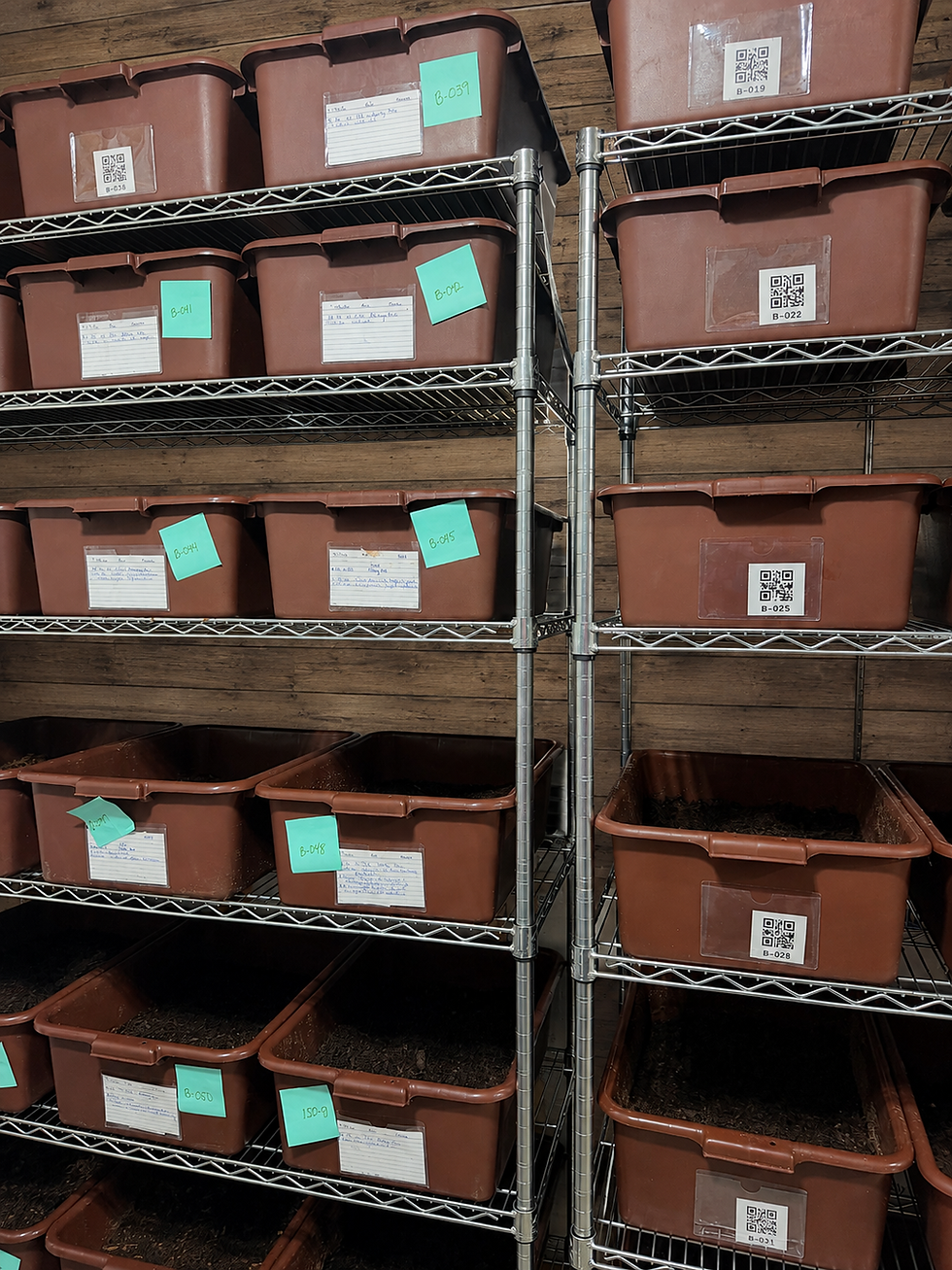
Eventually, my walk brought me back to the Worm Barn.
There, the same lesson exists on a much smaller scale.
I can lift a handful of bedding and find cocoons in different stages.
New hatchlings so tiny they almost disappear.
Juveniles.
Adults.
Microbes I cannot see at all.
Pieces of peanut compost becoming something else.

It would be very easy to look at a worm bin and see dirt and worms.
But that is not what it is.
It is an ecosystem.
A tiny one, yes.
A managed one.
But a living system nonetheless.
And every time I take worms from the larger world and place them into one of our bins, I feel the weight of that.
We control the moisture.
We choose the bedding.
We decide what they eat.
We determine their density.
We decide when adults move and when cocoons remain behind.
We are, in a very small way, taking responsibility for their environment.
That responsibility has made me think deeply about what commercial worm farming actually is.
Our commercial worm farm uses red wiggler composting worms in managed breeder, cocoon and grow-out systems to produce future worm populations and high-quality vermicompost and worm castings.
Because our goal is not simply to keep worms in plastic tubs.
The goal is to multiply life so that those worms can eventually leave us.
Into someone's compost system.
Into a garden.
Into another farm.
Into a classroom.
Into the hands of a child who has never turned over a handful of compost and watched something move.
Back into the living loop.
Why Compost Organic Material Instead of Throwing It Away?
That is also why we compost.
People often begin composting for different reasons.
Someone wants to keep food scraps out of the trash.
Someone wants to reduce waste.
Someone wants better soil.
Someone wants to grow vegetables.
Someone has animals and needs to responsibly manage manure and bedding.
A farmer may be trying to return organic matter to Florida sand.
A gardener may simply want to grow the best tomato of their life.
Different reasons.
Same loop.
How Compost and Worms Help Build Living Soil
On our farm, material that has already served one purpose can become the beginning of another.
Used animal bedding does not have to be the end of a story.
Manure is not simply something to dispose of.
Leaves are not trash.
Food scraps are not useless.
Composting used animal bedding and other organic material is one way we return carbon and organic matter to the soil instead of allowing those resources to leave the agricultural system.
Properly managed, those materials become feedstock for decomposition.
Microorganisms begin their work.
Organic matter changes.
Nutrients cycle.
Compost returns to soil.
Worms participate in another part of the process.
Plants grow.
Animals eat.
People eat.
And eventually organic material returns again.
For gardeners working with Florida's naturally sandy soils, increasing organic matter can be one important part of improving the soil's ability to support a living biological community.
Nothing is doing everything.
Everything is doing something.
I have thought about that sentence a great deal lately.
Our community, like many communities, has felt divided.
People seem increasingly convinced that agreement is the price of belonging.
Nature offers another model.
A functioning ecosystem contains enormous diversity.
Different organisms.
Different strengths.
Different needs.
Different jobs.
And somehow, when the system is healthy, those differences do not weaken it.
They make the whole thing possible.
Paul used the image of a body.
Many parts.
Different functions.
One body.
I see that truth everywhere on this farm.
Above the soil.
Below the soil.
Across fence lines.
Between generations.

I turned fifty last week.
I am trying to learn a new rhythm myself.
Work has always been the wall I know how to build.
If I am hurting, I work.
If I am worried, I work.
If I do not know what to do, I usually know what needs doing.
There is always another bin to check.
Another animal to feed.
Another bed to weed.
Another project waiting.
But this weekend I am trying something different.
I am going to tend what needs tending this morning.
Feed the goats.
Check the worms.
Do the work that belongs to today.
And then I am going to change gears.
Spend time with my family.
Listen to their laughter.
Look at their faces.
Let grief arrive when it arrives instead of immediately building another wall of work in front of it.
Maybe minute by minute.
Maybe ten minutes at a time.
I do not know yet.
It is a new rhythm.
But perhaps that is another thing the farm has been trying to teach me.
There is a season for growing.
A season for resting.
A season for breaking down.
A season for rebuilding.
Long days become short ones.
Leaves fall.
Roots slow down.
Worms keep working beneath the surface.
And nothing panics because the season changed.
The system simply moves into the work that belongs to the next season.
I do not think of myself as owning this land.
I never really have.
Too many people walked here before me.
Too many will walk here after me.
The old oaks alone make the idea of ownership feel a little ridiculous.
I am simply part of its story for a while.
A caretaker.
A student.
One living piece of something much larger.
And perhaps that is where we begin this series.
Not with the perfect compost recipe.
Not with arguments about carbon and nitrogen.
Not even with worms.
We begin by understanding that we have been invited into a living system.
You do not have to understand every part before you participate.
You do not have to do everything perfectly.
You simply have to begin paying attention.
Over the next few Field Notes, I am going to take you inside that system—from the compost that begins with materials other people might discard, into our commercial Worm Barn where breeders, cocoons and millions of future red wigglers are growing for the seasons ahead, and eventually into the small systems you can build at home.
No gatekeeping.
No arguing over who composts better.
Just learning together.
Because you do not have to run a farm to become part of the loop.
Sometimes it begins with nothing more complicated than a handful of soil.
A few kitchen scraps.
A small bin of worms.
And curiosity about what happens next.
Good soil grows good days.
And good things grow when each of us learns the part we were given to play.
— Fant Farm Field Notes
Morriston, FloridaKeep Going
Part Two of The Living Loop goes inside the commercial Worm Barn — breeders, cocoons, and how red wigglers actually reproduce.


Comments