
There's No Crying, and There's No AI, in Farming — Just Farm Recordkeeping Systems

So I built an app for that.
I'm going to tell on myself right up front.
I am a data nerd.
Not a reluctant one. Not a farmer who got dragged into recordkeeping by a regulation. A genuine, lifelong, unembarrassed data nerd who thinks a well-built spreadsheet is a kind of poetry.
For years I've painted my office walls in dry erase paint or completely covered them in a patch work of dry erase panels. All of them.
Because I don't think in paragraphs, I think in fields and columns and arrows, and I needed the numbers up where I could see them and argue with them.
I built spreadsheets in those years that linked information to information to information, and when one of them finally clicked into place it was as satisfying as anything I've ever made with my hands.

You mostly know me for the other thing. The soulful posts. The seasons and the grief and the oak tree and the poetry of a place.
That's real and it isn't going anywhere.
But this is the other half of me, and it's the half that keeps this farm alive.
IF SOMEBODY ASKS YOU THE SAME QUESTION TWICE, YOU HAVE A DATA PROBLEM
I used to train people, and this was the rule I gave them:
If you have to go find the same answer more than once, stop finding it.
Start tracking it.
You should never be backtracking.
You should never be reconstructing something you already knew last month.
The answer should be at your fingertips so you can look at it and move on with your day.
That rule is the entire foundation of my farm recordkeeping systems now.
And farms need it more than any business I've ever touched.
The sheer volume is what shocks me still — the inventory, the animals, the buildings, the equipment, the seasons, the timing, all of it demanding attention at once.
It's overwhelming by design.
FIRST YOU CLEAN THE BARN. THEN YOU CLEAN THE
DATA.
Here's how I approach any space, and I approach data the exact same way, because they are the same problem.

Get the garbage out. Everything that isn't needed, gone. You cannot organize around junk.
Then watch how people move. Where do we walk? What do we pick up first? What do we carry twice? I keep editing the barn — moving racks, moving tools, moving the water — until the number of steps drops. I will move a hose three times over a month to save four steps a day, and I'll do the math on it, and I'll enjoy the math.
Then build the process. Whoever walks in that barn should know what they're there for before the door closes. Not guessing. Not asking me. And it should carry all the way through the day — the checking, the feeding, the sterilizing of tools between bins so nothing crosses, the cleanup, and the record at the end.
That's an SOP. Standard operating procedure. Fancy words for we all do it the same way so the result is the same regardless of who showed up. Consistency.
And that's the phrase I'm going to keep coming back to around here, so let me plant it now: scalable, repeatable systems.
Scalable means it still works at ten times the size.
Repeatable means it doesn't depend on which one of us walked in.
Everything I build on this place has to be both, or it isn't built yet — it's just me doing a chore.
If that sounds like a business concept dropped onto a farm, look closer.
It's the design process. Site analysis, rough draft, refine, build. It's what I've done my whole working life, and it works identically on a room, a business, and a worm barn.
THE INDEX CARDS
I want to be clear about this, because the story people expect is poor thing was drowning in paperwork until technology saved her.
That is not what happened.
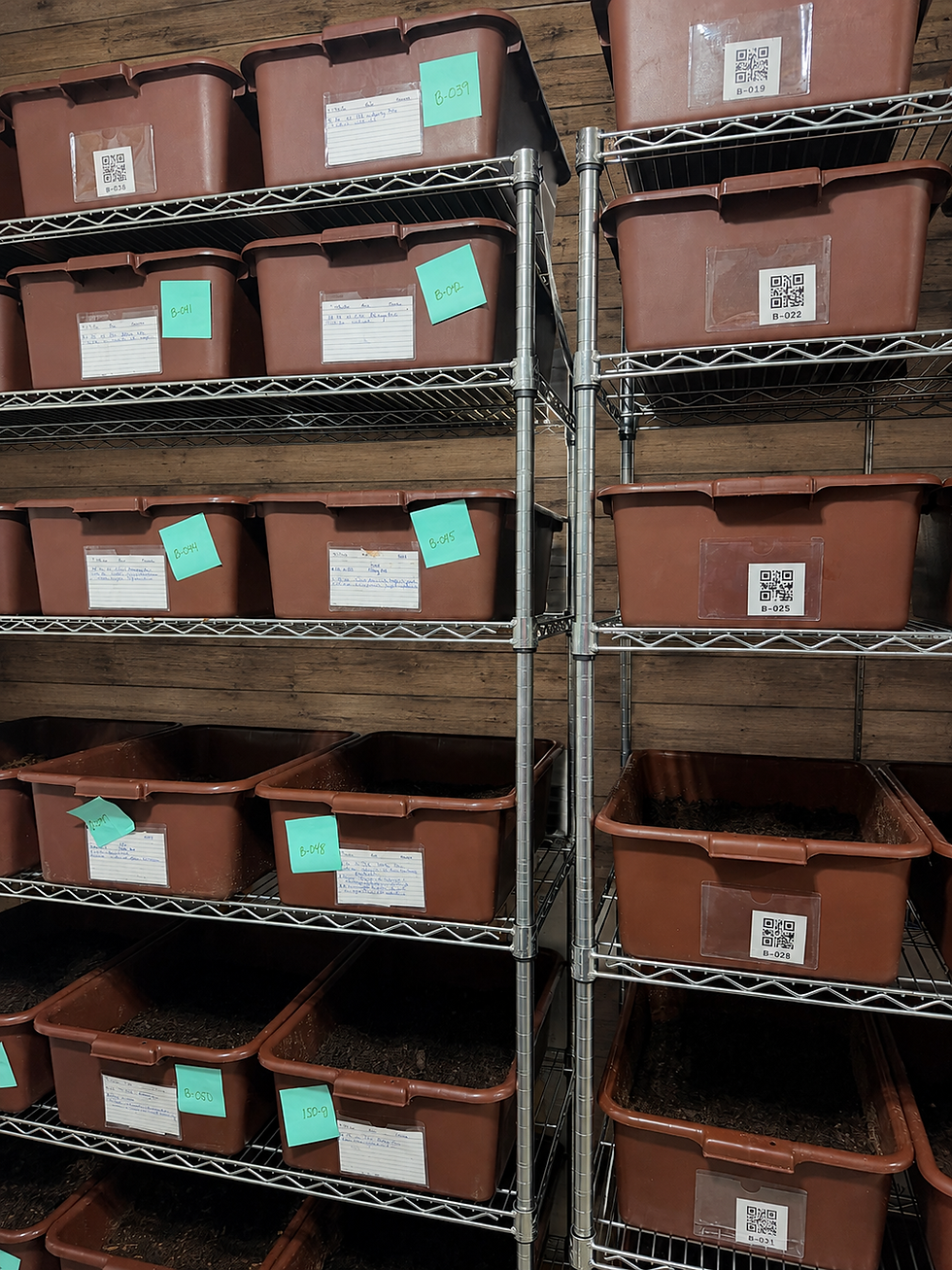
When I ordered the breeder bins, I ordered plastic sleeves at the same time. Clear ones, mounted on the front of each bin — the same thing a kindergartener has on her cubby.
An index card slid into every sleeve, labeled, in front of the bin it belonged to.
That was deliberate. I knew before a single worm arrived that I was going to label and trace everything.
This is the rough draft, and you cannot skip the rough draft.
You don't know what data you need until you've collected the wrong data for a while. And it's not really the wrong data–it's the rough draft.
Months of index cards taught me exactly which questions actually mattered, which ones I never once looked back at, and where three different people were describing the same bin three different ways.
One card said looks good. One said robust, lots of babies. One said fine.
That's not a failure. That's an outline. Outlines are supposed to be worked and edited until they flow. Until they are right.
SO I BUILT AN APP FOR THAT

There's no crying or AI—in farming.
Both of those are lies, and I'm the proof. I've done a considerable amount of crying and I bring in a considerable amount of AI, and I intend to go right on doing both.
But I've only solved one of those two problems, and I'll be honest about which.
Nobody has yet built me a large language model that will hold my hand in a hundred-degree field while I hunt for a shear bolt in the sand. I've checked. If you find one, send me the link.
The other problem, though? In 2026, with the tools sitting right there, I can build the fix myself. And I did.
Every bin has a code on a sticker now. Scan it and the bin's whole life comes up. Log the new check by talking to it, because I do my best thinking with my hands in something and I have never once stopped mid-task to write a paragraph.
It took four rounds of me saying no, that's not how we do it before the form asked the right questions in the right order — and that's fine, that's the process. It still won't export a backup properly on an iPhone and I've got to move it onto a better foundation this month. Nothing arrives finished. Anybody who tells you otherwise is selling something.
Here's what it actually bought me:
One vocabulary for different people. Same questions, same order, same choices. Very dry, dry, just right, wet, too wet. Nobody invents language at seven in the morning. My husband's observations, my daughter's, helper's and mine are finally comparable.
A daily assignment instead of a guess. Yesterday afternoon I pulled the bins that had gone longest without hands on them, and that was the plan. No walking the racks trying to remember. There are hundreds of bins now, and that number only goes one way.
A more uniform product. This is the part people miss. Consistent care, caught early, means a struggling bin gets attention on day two instead of day twenty. The castings are more consistent because the care is more consistent.
Traceability that holds up. Every bin, every check, who and when. As folks around here have made clear, people do ask.
And I'll say the nerd part out loud: it's fun. I loved the spreadsheets. I love this more.
I built a working app for my own barn, by myself, in my own words, and it does what I told it to do.
WE CALL THIS PLACE A LIVING LABORATORY. LABORATORIES TAKE NOTES.
At some point we started describing Fant Farm Organics as a living laboratory.
A laboratory is science. Science is observation, written down, over time. There's no version of it where you watch carefully and then don't record it.
And there is no substitute for being out there. You can read every book — I have read a great many books — and still not know what a healthy bin smells like or how a pasture looks the week it decides to come back. That you learn standing in it, with your hands in it, being part of the thing.
But here's the trap: what you learn standing in it disappears if you don't write it down. Seasons blur. You end up holding an outcome with no idea what produced it, and making the same decision next spring from scratch. That isn't experience. That's guessing repeatedly with confidence.
Data is what turns being there into knowing something.
AND THIS IS WHERE IT GETS BEAUTIFUL

Because once the records are clean, I can finally see the whole chain.
Better biology in the bins means better castings. Better castings and worm tea mean more robust soil microbes. Robust microbes mean stronger plants that resist pests without me reaching for anything. Stronger plants mean better forage. Better forage means healthier goats and sheep and cows. Healthier animals and better ground mean better food for the people we feed.

Every layer is feeding the layer above it. That's the regenerative system. That's what people mean by community, and I don't mean it as a metaphor — I mean microbes and worms and plants and insects and livestock and us, all in one working arrangement, every one of them responding to what happened underneath.
And I cannot make a single honest claim about any of it without data.
Not carbon sequestration. Not soil recovery. Not impact. Those aren't feelings, they're measurements.
If I want to say this farm is doing something real for the ground and the water and the air, I have to be able to show it.
And this is the part I'm most excited about, so forgive me while I brag on my kid.
My daughter Kyra is in a master's program in agriculture at the University of Florida, and she works this farm with us. Which means the data doesn't stop at my app. She can pull it into R — statistical software, the real tool, the one actual researchers use — and do things with it that I cannot do from a spreadsheet no matter how much I love one.
Regressions instead of hunches. Which variables actually predicted a response and which ones I only believed mattered. Whether the difference between two paddocks is real or just noise I got attached to.
And then the big one: carbon. What our composting operation is actually doing to the carbon equation. What we're sequestering in that soil and what we're emitting to get there. Nutrient cycling, water retention, organic matter climbing over seasons — measured, modeled, and defensible.
That's the whole reason I keep the records clean. Because a mother and daughter standing in a barn saying the ground is getting better is a nice sentiment. The same two people with four years of structured observations and a statistical model is evidence.
That's the part that gets me out of bed. Not the spreadsheet. What the spreadsheet proves.
Which is why I'll say it plainly: the data is the poetry. It's the only way I get to meet this living community on its own terms and understand what we're actually doing to each other.
And the bin tracker is only one of several.
It's one app in a suite I'm building for this farm, and the rest are already underway.
A windrow app for the compost operation — temperatures, turns, moisture, rainfall, every pile with its own history.
A regeneration app to log the ecosystem I'm trying to join: wildflowers by season, butterflies, insects, the rabbits, everything that shows up and everything that doesn't, so I can tell whether I'm actually supporting this place or just standing in it.
A livestock app for worming, feeding, breeding, births, and plantings.
And I fully expect that list to keep growing, because I don't think in a straight line. I think in loops — whiteboard, circle back, search, connect it to the thing I noticed three weeks ago, start over one layer deeper. Every loop turns up another place where a system belongs. And I get so excited!
SO — HOW DO YOU FIND THE TIME?
That's the real question, and I know it, because I live it.
You feed at first light. You work all day. You come in dirty and tired and you'd rather put your boots by the door than open a laptop.
Nobody gets into farming for the record keeping, and during planting and harvest there is no such thing as a spare hour.
And yet the records still have to happen — not just receipts for the bookkeeper, but the real ones. What we did, when, in what conditions, and what came of it.
So the trick isn't discipline. It's design. Fewer steps, one vocabulary, capture it where the work happens instead of at eleven at night.
Ask four questions about every task on your place — how often, how long, how much judgment, how much of you has to be in the answer — and the ones that come out constant-and-thoughtless are the ones to hand off first.
That's the whole method, and it works on a hundred bins or three raised beds. Scalable, repeatable systems. Say it enough and it stops sounding like a business seminar and starts sounding like relief.
Here's my honest question for you: do you want me to teach this?
Because it's what I actually know. I know it from a lifetime of being the person who paints the walls with dry-erase paint, and I know it from paying dues I'd rather not have paid. Trial by fire is a curriculum, and I passed.
If you want the systems side of farming — how to spot where you need a process, how to build one, how to get your data working for you instead of the other way around — say so and I'll write it.
And if you'd rather I stick to the soil and the worms and the oak trees, that's a fine answer too.
There's room for both.
Either way, I'll be in the barn. Happily. With my phone in my hand and dirt on the screen.

Ellie Fant farms in Levy County, Florida, where her family has worked the same ground since 1860. Fant Farm Organics is a registered composting and vermiculture operation producing compost, soil blends, composting worms and worm castings.
Questions I get asked about this...
Do small farms really need recordkeeping systems?
Yes. A working farm generates constant data — feedings, treatments, temperatures, births, inventory, conditions — and without a system that information exists on scraps and in memory. Farms that run on documented, repeatable processes make better decisions, produce more uniform product, and are worth more to a lender or buyer than farms that run on one person's recall.
What is an SOP on a farm?
An SOP, or standard operating procedure, is a written process that produces the same result regardless of who performs it. On a worm operation, an SOP covers what to check on entry, how to record moisture and population, when and how to sterilize tools between bins, and what gets logged at the end of the day.
How do farmers find time for recordkeeping?
By designing the record into the work rather than saving it for the end of the day. Capture data where the task happens, use fixed answer choices instead of free writing, allow voice entry, and hand off any task that happens constantly and requires no judgment.
Can AI actually help on a small farm?
AI cannot assess a living system — a person has to stand in the barn and judge whether a bin is healthy. What AI does well is build and hold the repeatable parts: tracking systems, reminders for treatment windows, structured logs, and documentation. Fant Farm Organics used AI to build a custom bin tracking application specific to its own operation.
How do you track worm bins?
Assign every bin a unique code on a durable label, then log each check against that code with the same questions in the same order every time: who checked it, whether it was fed, moisture level from a fixed scale, temperature, population condition, and whether it needs follow-up. Consistent fields are what make bins comparable over time.
Why does data matter for regenerative claims?
Soil recovery and carbon sequestration are measurements, not impressions. Making an honest claim about environmental impact requires baseline data, consistent observation over seasons, and records clean enough for someone else to analyze.


Comments